| Criterion | Electric bike | Electric scooter | Planning use |
|---|---|---|---|
| Typical range | 30 to 60 miles per charge with motor plus pedal assist | 10 to 30 miles per charge on battery power alone | A long or repeated daily trip favours the bike. Short hops suit either. |
| Typical weight | 50 to 80 lb for a commuter e-bike | 30 to 40 lb, and it folds flat | Stairs, trains and small hallways favour the scooter. |
| Wheel size | 20 to 29 inches | 8 to 11 inches | Bigger wheels cope better with broken pavement. |
| Top speed | Up to 28 mph, depending on class | Up to 25 mph on average, depending on model | Local legal limits matter more than the headline speed. |
| Riding position | Seat, with pedalling | Standing only, throttle driven | A seat suits longer rides. Standing suits short, quick trips. |
These figures come from Aventon’s commuting comparison and Ride1Up’s buying guide.
In the electric bike vs electric scooter decision, the scooter wins on weight and portability. The e-bike wins on range, comfort and rough pavement, so the right pick depends on how far and where you ride.
Safety gear is the same kind of decision, and the guide on what safety gear do you need for electric scooters covers it for any wheeled ride. The sections below take the common situations one at a time, from daily commuting to the moped question.
Range, battery and motor power
An electric bicycle generally goes further on a charge than an electric kick scooter. Aventon puts typical e-bike range with motor plus pedal assist at 30 to 60 miles per charge, against 10 to 30 miles for a scooter running on battery alone. Ride1Up’s figures point the same way: about 20 miles for the average scooter, and 20 to 35 miles or more for an e-bike under the same conditions.
The gap matters most when a rider cannot charge at the destination. A scooter that manages 10 miles on a charge leaves little spare for a round trip, while a typical e-bike leaves room for detours.
Battery capacity
Battery capacity is the spec that explains range, and makers quote it in different units. Aventon lists its Level 3 e-bike with a removable 733Wh battery and range of up to 70 miles. That is a maximum, so plan around the typical ranges above rather than the ceiling.
Scooter makers often quote volts and amp-hours instead. Freeboy describes its J11 Max with a 1200W motor, a 48V 18Ah battery, a top speed of up to 55 km/h and about 45 km of range. That is a performance-oriented scooter. Its numbers show how far a high-power model can sit from the mainstream averages.
Motor wattage
Motor wattage describes power, not legality or range on its own. Aventon’s Soltera 3 uses a 250W motor, pedal assist only. Its Level 3 uses a 500W motor with a throttle. Compare watts alongside battery capacity and the legal class, not as a stand-alone score.
Daily commuting
For a regular commute, the e-bike is the more comfortable tool and the scooter is the lighter one. Ride1Up notes that e-bikes and mopeds offer a seat, while electric scooters only offer the option to stand. Standing is fine for a short hop. On a longer route a seat matters more.
Effort differs too. Ride1Up says a scooter relies solely on its throttle and asks almost no physical engagement from the rider, while e-bike pedal assist needs pedalling. Riders who want light exercise lean to the bike. Riders who arrive at work in office clothes may prefer the scooter’s low effort.
- Choose the e-bike for a route that is long, hilly or repeated daily, or when carrying bags matters. A rack and panniers add cargo capacity that a stand-up scooter cannot match.
- Choose the scooter for short, flat links such as the last stretch from a station. Entry-level models start around $300, according to Aventon.
- Expect less upkeep on a scooter. Freeboy says scooters generally have fewer mechanical components than electric bikes, which means fewer moving parts and less maintenance.
A bike left outside needs a solid lock. The roundup of the best bike lock options for city riding helps with that choice, and the same reasoning applies to a scooter that cannot be carried indoors.
Trains, stairs and small apartments
The scooter is easier to carry on trains and to store in an apartment. Aventon says a typical e-scooter weighs 30 to 40 lb and folds flat, while an e-bike weighs anywhere from 50 to 80 lb. Its own Level 3 weighs 67 lb and is built to be a car replacement. Its Soltera 3 weighs 37 lb, roughly half as much, which brings a light e-bike into scooter territory.
Weight decides stairs. A scooter can be lifted with one hand onto a platform or into a hallway. A heavy e-bike is a two-handed job, and a ground-floor or elevator building suits it better. If the plan is to carry the vehicle every day, a light bike like the Soltera 3 is worth comparing against a scooter in the same weight range.
Folding is the scooter’s other advantage. A flat-folded scooter tucks under a desk or beside a seat. A bicycle takes more floor space even when the weight is manageable. Transit operators set their own carriage rules for bikes, scooters and batteries, so check the operator’s current policy before boarding with either.
Rough pavement and promenades
The e-bike is safer and steadier on rough surfaces because of its larger wheels. Aventon gives e-bike wheels as usually 20 to 29 inches, against 8 to 11 inches for a scooter. Ride1Up adds that scooters have smaller wheels, making it more difficult to ride safely over bumps or potholes.
On a smooth promenade or bike path the difference shrinks. On cobbles, cracked asphalt, tram tracks or plank boardwalks with gaps, a small wheel drops into joints and delivers every bump to the rider’s legs. Slow down on a scooter in those spots, and look for models with pneumatic tires, which are worth checking on any machine you ride on uneven ground.
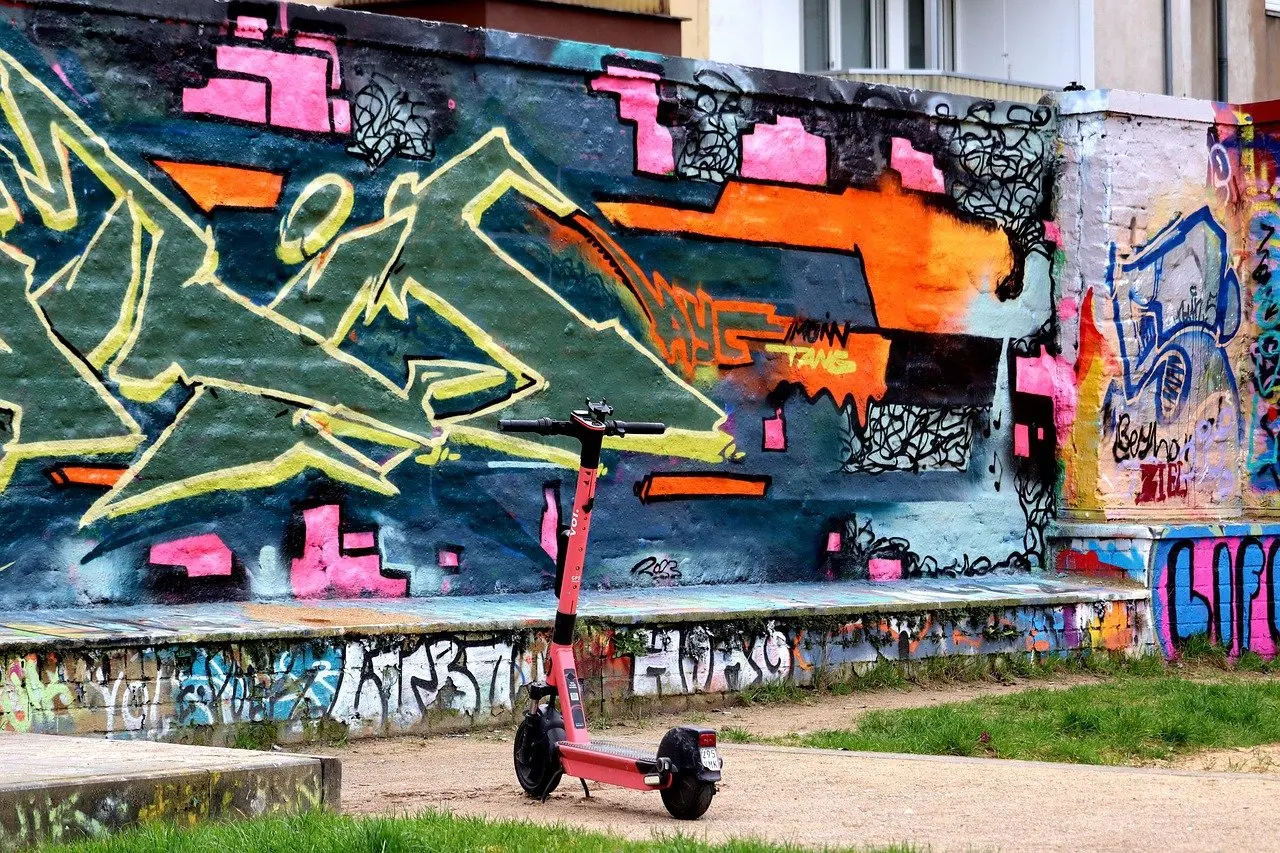
- Smooth paths: either vehicle works, and the scooter’s lighter weight is an advantage.
- Mixed or broken surfaces: the e-bike’s bigger wheels give a steadier ride.
- Crowded boardwalks: a slower, more upright ride gives more time to react, whichever vehicle is chosen. Local rules may also restrict wheeled vehicles on promenades.
Legal limits and riding classes
E-bike law is built around classes, and these caps differ from those for scooters. Aventon explains that Class 1 e-bikes, pedal assist only with no throttle, are capped at 20 mph. Class 2 e-bikes add a throttle, typically capped at 20 mph on throttle power alone.
Scooters are not sorted by those classes in the supplied specs, and their rules vary by city and state. Check the local vehicle code for speed, power and where scooters may be ridden before buying a fast model. Top speeds above the local cap give no legal benefit. The guide to ebike classes explained sets out how the class system works and which class suits which rider.
Access is the practical legal difference between these vehicles and mopeds. Ride1Up says scooters and e-bikes are generally allowed in bike lanes, in parks and on most walking paths. Mopeds, by contrast, share the lane with cars.
E-scooter vs moped
An electric kick scooter is a different vehicle from a moped, even though the names overlap. A moped has a seat, as does an e-bike, while an electric scooter is stand-only. The biggest consequence is where each can legally go, since a moped rides with cars and the kick scooter can use bike lanes, parks and most walking paths.
The distinction matters for choice. A rider who wants a seat and road speed in traffic is shopping for a moped-type vehicle, with the rules that come with it. A rider who wants something to ride on shared paths and fold into a bag-sized space is shopping for a kick scooter or an e-bike.

The photo below shows a step-through scooter with a seat and a helmet hung on the handlebar, a body style that is closer to the moped side of the line.

Scenario chooser
These shortcuts reduce the comparison to the situations riders raise most often.
- Best portable electric ride for travel: the scooter, because it folds flat and weighs about 30 to 40 lb according to Aventon. A light e-bike near 37 lb is the alternative for riders who need more range. Airlines and transit operators set their own battery and carriage rules, so confirm them before any trip.
- Boardwalk or promenade cruising: an e-bike for comfort and stability, or a scooter on smooth, uncrowded paths. Check local limits on wheeled vehicles first.
- Longer commute with bags: the e-bike, with a rack and panniers.
- Walk-up apartment or shared office: the scooter, since it is the one that can be carried and folded.
- Seated, road-speed riding in traffic: look at mopeds, and accept the road rules that come with them.
Frequently asked questions
Is an electric bike or an electric scooter better for commuting?
The e-bike suits longer or repeated commutes because it offers a seat and typically goes 30 to 60 miles per charge. The scooter suits short, flat links where weight and folding matter more.
Which is safer on rough pavement?
The e-bike, because its wheels are usually 20 to 29 inches against 8 to 11 inches on a scooter. Smaller wheels struggle over bumps and potholes.
Do e-bikes and e-scooters need the same power limits?
No. E-bikes are grouped into classes with speed caps, such as 20 mph for Class 1 and a 28 mph maximum for Class 3. Scooter limits depend on local rules, so check the local vehicle code.
Is a scooter the same as a moped?
No. A moped has a seat and shares the lane with cars. An electric kick scooter is stand-only and is generally allowed in bike lanes and on most walking paths.